

The Hidden Cost Trap in Pre-Engineered Steel Buildings — And How to Spot It Before You Sign
A steel building buyer in Ohio signed a contract for $260,000. Their final cost was $385,000. That’s not a rounding error — it’s a $125,000 gap between what the quote promised and what the project actually required, and it happened because nobody asked the right questions before signing.
If you’re evaluating pre-engineered steel building (PEB) proposals right now — for a warehouse, a plant expansion, or a new facility — the quote sitting in your inbox may be doing the exact same thing to you. Not through fraud. Through omission. And omission is legal.
Why “Kit-Only” Pricing Is the Industry’s Best-Kept Secret
Most steel building quotes you’ll receive in 2026 are kit-only. That means the number on the page covers the primary structural steel — columns, rafters, girts, purlins — and little else. It does not typically include:
- Foundation and slab work
- Delivery, freight, and unloading coordination
- Insulation and interior finish systems
- Installation labor
- Engineering upgrades for wind, snow, or seismic loads specific to your site
None of this is hidden maliciously. It’s industry-standard scoping. But when three vendors hand you three numbers and only one of them discloses what’s excluded, you’re not comparing quotes — you’re comparing apples to a much more expensive orchard.
“engineering upgrades for wind, snow, or seismic loads”
The Real Numbers: How a $260K Quote Became a $385K Project
Take the Ohio example again. A 10,000-square-foot steel building shell was quoted at $260,000 in late 2025. By the time the owner accounted for site prep, permits, foundation complications, and material upgrades, the total landed at $385,000 — a 48% increase over the original number.
This is not an outlier. Tight regional labor markets, oversized-freight surcharges, and site-specific foundation conditions are pushing 2026 project costs up in ways that rarely show up in an initial proposal. The pattern is consistent: the steel is priced tightly to win the bid, and everything the steel sits on, ships with, or gets wrapped in is priced separately — after you’ve already committed.
External link opportunity: cite a recent industry cost guide (e.g., a 2026 metal building cost-per-square-foot report) to back this figure with a third-party source.
The 7-Point Quote Checklist Every Buyer Should Run
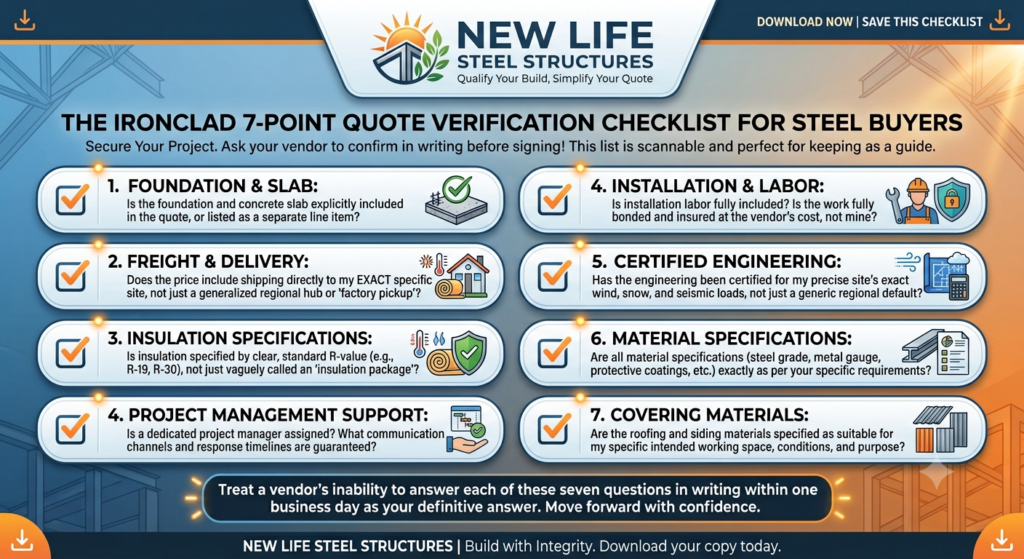
Before you sign anything, ask your vendor to confirm — in writing — each of the following. This list is built to be scannable on its own, because it’s the one thing worth screenshotting from this article.
- Is the foundation and slab included, or is it a separate line item?
- Does the price include freight and delivery to my specific site, or just “factory pickup”?
- Is insulation specified by R-value, or just listed as “insulation package” with no standard?
- Is installation labor included, and is it bonded/insured at the vendor’s cost or mine?
- Has the engineering been certified for my exact site’s wind, snow, and seismic loads — not a generic regional default?
- Is the material specifications as per my requirement or not ?
- Does the covering materials suitable for my working space or not?
If a vendor can’t answer all five in writing within one business day, treat that as your answer.
The Three Line Items Owners Underestimate Most
Freight
Steel building components are oversized loads. Cost scales with distance from the manufacturing facility and with current fuel and trucking capacity — both of which have been volatile through 2026. A quote that says “delivery included” should specify to what radius.
Foundation
Soil conditions, water table depth, and local frost-line requirements can swing foundation cost by tens of thousands of dollars. This is almost never priced until a geotechnical assessment happens — which is exactly why it should happen before you sign, not after.
Labor
In tight regional labor markets, installation crews are booked out and priced accordingly. A vendor quoting “installation available” without a locked labor rate is leaving themselves — and you — exposed to whatever the market does between signing and groundbreaking.
Internal link opportunity: link this section to a case study or project-gallery page showing a completed PEB project with a transparent cost breakdown.
What a Trustworthy Quote Actually Looks Like
A vendor who has nothing to hide will hand you a proposal that itemizes structural steel, foundation, freight, insulation, and labor as separate, named line items — not a single bundled number. That structure isn’t a sign the project is more expensive. It’s a sign you’re finally seeing the real price.
Frequently Asked Questions
What does “kit-only” mean in a steel building quote?
It means the price covers only the primary structural steel components — not the foundation, freight, insulation, or installation labor, all of which are typically priced separately.
How much can hidden costs add to a pre-engineered steel building project?
Based on recent project data, hidden and unscoped costs have added 30–48% to initial quoted prices, depending on site conditions, freight distance, and labor market pressure.
What’s the single most important question to ask a steel building vendor?
Ask whether the quote includes foundation, freight, insulation, and installation labor as itemized line items — or whether those are quoted separately after signing.
Is a higher upfront quote always more expensive in the end?
Not necessarily. A higher, fully itemized quote often ends up cheaper than a lower kit-only quote once excluded costs are added back in during construction.
Conclusion
The gap between a $260,000 quote and a $385,000 invoice isn’t a construction problem — it’s a scoping problem, and it’s entirely preventable. The five questions above take one phone call to ask and one email to get in writing. That’s a small amount of friction against a six-figure risk.
Talk to our team before you sign anything. We’ll walk your existing quote against this checklist, line by line, at no cost — so you know exactly what you’re buying before you buy it.