

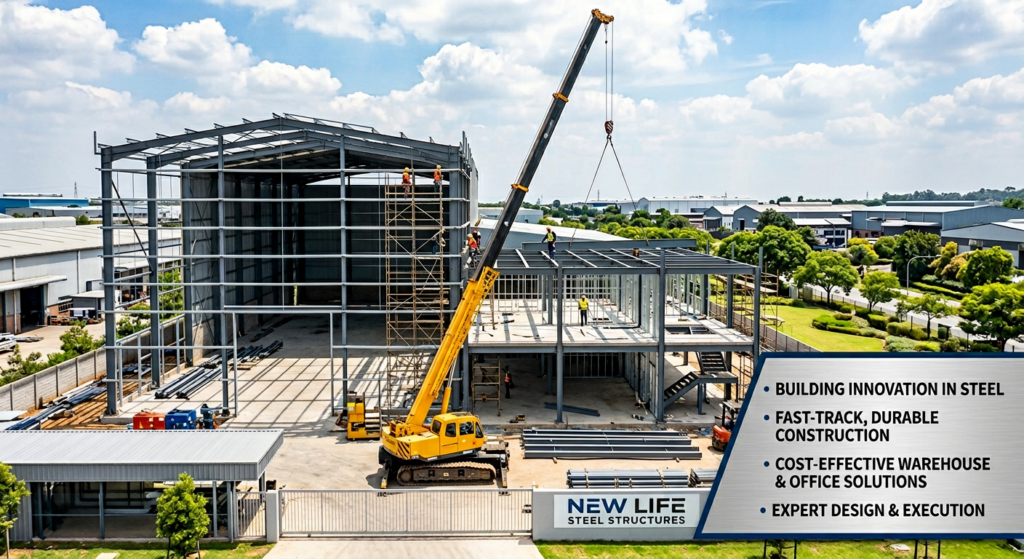
In the world of industrial scaling, the sound of a silent construction site is the sound of hemorrhaging capital. For decades, the “bricks and mortar” approach was the industry standard, but in an era of extreme market volatility, the luxury of waiting has become a liability. Legacy construction methods—plagued by labor shortages, weather-induced delays, and unpredictable budget creep—can no longer keep pace with the velocity of global commerce.
Modern industrial giants are no longer asking how to build; they are asking how to build now. This urgency has sparked a paradigm shift toward high-precision engineering. Leading this transition is New Life Steel Structures, an ISO 9001:2015 certified firm that has spent over 35 years refining a philosophy of “innovation and improvisation.” Since 1992, they have been the architects behind a quiet revolution that treats buildings not as static masonry, but as high-performance, scalable tools.
Speed as a Competitive Edge: The 50% Time-Saving Breakthrough
The most compelling argument for Pre-Engineered Buildings (PEB) is the radical compression of the “speed-to-market” interval. In a global economy, the ability to bypass traditional timelines is a massive driver of Return on Investment (ROI). When a facility is operational months ahead of schedule, the business benefits are compounded: interest on construction loans is minimized, and the ability to fulfill seasonal contracts or scale production becomes a first-mover advantage.
According to data from the field, the efficiency of the PEB model offers a breakthrough in project management:
“Project timelines depend on size and complexity, but PEB construction is significantly faster than conventional methods, often reducing overall project time by 30–50%.”
For a developer, this “50% Rule” isn’t just a statistic; it is a fundamental shift in business logic. Starting operations half a year early can be the difference between capturing a market and being locked out by a more agile competitor.
Customization Beyond the “Cookie-Cutter” Myth
There is a persistent misconception that “pre-engineered” implies a lack of variety—a sterile, one-size-fits-all approach. In reality, the modern PEB is a masterclass in site-specific improvisation. These structures are custom-designed from the ground up, factoring in complex load calculations, local climate data, and specific functional requirements ranging from specialized cold storage to massive airport hangars.
This versatility is visible in the global footprint of New Life Steel, stretching from the industrial hubs of Mumbai and Bangalore to the emerging markets of Nigeria, Togo, and Dubai. The architectural flexibility of the medium is perhaps best demonstrated through its interior and exterior optimization:
- Interior Optimization: PEB engineering allows for massive, clear-span interiors that maximize usable floor space by eliminating the need for frequent support columns. Note the integration of skylights; these aren’t just for aesthetics, but provide natural lighting that reduces long-term energy costs—a hallmark of sustainable industrial design.
- Exterior Diversity: Projects highlight the clean lines and specialized finishes available. These images prove that industrial strength can coexist with professional, tailored design, allowing a warehouse or factory to reflect a brand’s identity while maintaining a lower carbon footprint through precision manufacturing and reduced on-site waste.